

Won’t a radiant ceiling lose heat through the roof?
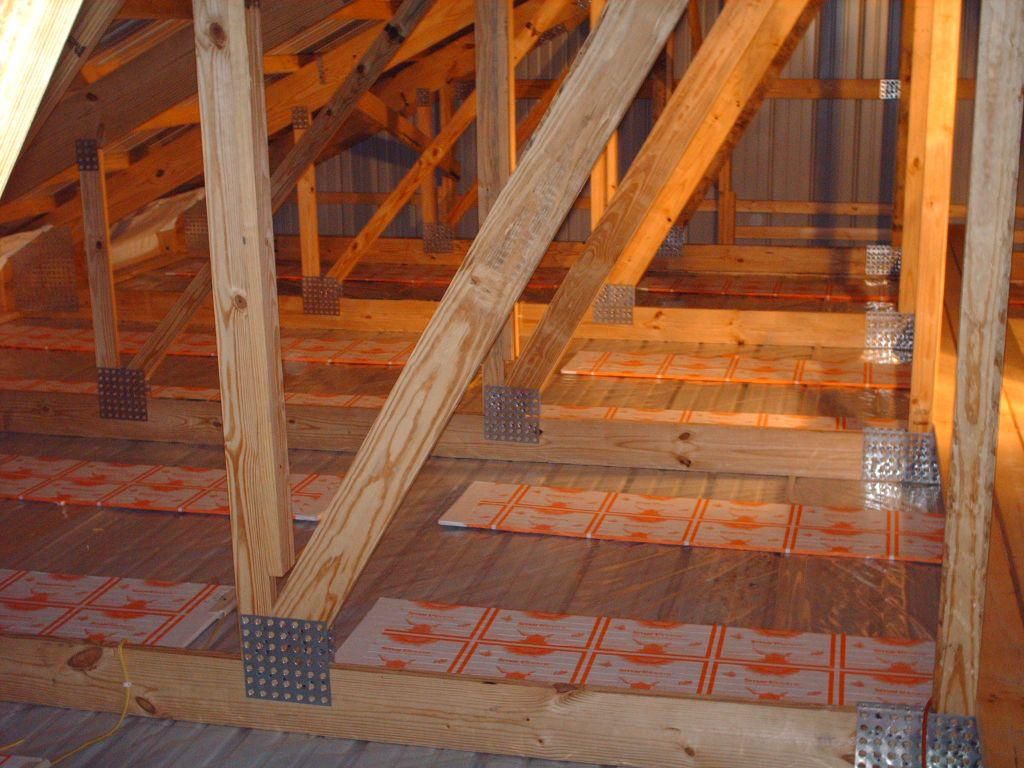
Not if the ceiling is insulated properly. Drywall has a very low R-value, and the radiant energy passes right through it, while the insulation above sends the heat down into the room. On a cold day, a thermal camera in the attic shows no heat coming through.
The conversation
I am adding a ~220 sq ft shop to the side of my residential detached garage. The purpose is for a small workshop for motorcycles and snowmobiles. I am interested in the ThermaRay in-ceiling radiant heat system to heat the shop. The shop is about 12 ft wide with a sloped ceiling (3:12 pitch). I’d like to hear how you think this ThermaRay system would work in this situation. I don’t want any heater taking up wall space, so ceiling/radiant makes the most sense to me. I’ve read all of ThermaRay’s literature.
The one question that is never addressed is how is it justified to put the ThermaRay panels behind the sheetrock? Sheetrock is an insulator. Yes, when warmed up, I understand how the sheetrock will radiate the heat into the room. But even with 12″ of fiberglass insulation between the joists, it seems that a lot of heat would be lost in an upward direction. Can you explain how this ThermaRay “in-ceiling” system could be more efficient than electric radiant panels installed below the sheetrock? Thanks for any help you can offer. I’m ready to order if I can be convinced that I wouldn’t simply be losing a lot of the heat produced straight up through the roof.
Thank you for your interest and inquiry. Your application is one of our most common installations. Although sheetrock does have insulation properties, or an R-value if you will, it is a very low R-value and the radiant rays easily pass through the sheetrock. Two layers of 5/8″ sheetrock is common, and we also install our heating panels above ½″–¾″ wood ceilings and below ¾″ wood subfloors, and those have even higher R-values. If insulated properly, you will lose no heat through the roof.
With one of our ceiling installs, you could take a thermal imager into the attic on the coldest day of winter and not see any heat radiating through the insulation. The insulation directs the heat into the space. I can provide hundreds of references that have the ceiling system installed, some of them with over 40 years of use and no issues or maintenance.
If it is new construction, we can also install below the concrete with our Thermal Mass Floor Heating System.
Thank you, Don, for the quick and informative answers. The slab has already been poured, so I will need to go with the ceiling system. I’m ready to move forward with getting a quote.
Added information: the interior space is 15 × 12 feet, so only 180 sq ft, vs. the 220 sq ft I mentioned before. The ceiling joists are on 24-inch centers. The shop is framed in, but electrical has yet to be run. I have 120 or 240 volt at my disposal.
Our house is at 7,000 feet elevation, and for instance, last night got down to −4°F, although below zero is rare. The space will be insulated with max standard insulation for 2 × 12″ joists and 2 × 6″ studs. There are two normal-size windows and an 8-foot garage door in the space. Most of the time the man door to the main garage will be open, so heat will be shared with the main garage (gas infrared heater). But I will want a separate thermostat for the new shop.
Attached is your proposal along with a rough layout. I only say rough because there may be some obstructions that will interfere with our layout. You will just need to verify that the model chosen (18″ wide × 5′ long) will fit in the spaces you have available as shown in the layout.
I also wanted to ask if your garage door is an insulated garage door?
Yes, the garage door will be insulated. I’m a little surprised we need 1,920 watts. I have no reason to think this isn’t accurate. Just some other calcs I’ve made myself make me think I’d only need 1,400 to 1,500 watts. Your higher wattage number is probably based on the −4°F outdoor temperature I mentioned, or an uninsulated garage door, or the higher ceiling in the shop. But like I said, those below-zero temps are kinda rare. Our normal winter lows are ~15°F.
The only obstructions we will have are the lighting in the ceiling, the garage door opener and tracks, and a ceiling outlet. But all of those are attached to a joist and shouldn’t interfere with the heat panels. Is it OK to have an LED shop light mounted under a heat panel, or should the light be run along the joists so they don’t cross under a heat panel?
I trust your advice on total panel wattage way more than mine, so I’ll rely on your suggestion. But if there is a realistic reason to lower the wattage, let me know. The bottom line is I’m not trying to skimp. I want the panels to heat the room in the best way.
Our rule of thumb is typically 6–8 watts per square foot on a normal room in a home, so your calculations are pretty stellar. It’s harder to heat a small space than a large space, and this is a very small footprint with 3 cold walls. I never like to rely on heat from another source supplementing the space, so I took that out of the equation for a worst-case scenario. The garage door, even if it is insulated, was a big factor as well, because most insulated garage doors still have a low R-value. All those factors and your comments pushed me to err on the side of caution.
If this was my personal project, this is what I would install. However, since I feel we’re on the same page, if you’d like to go a little lower in watts per square foot and take out a panel or two, I will be happy to oblige.
The LED lights don’t affect the heating system, but the heating system may shorten the life of the transformer or the light if it’s mounted directly to the sheetrock below a heating panel. If it’s not mounted directly to the ceiling and there is a little space, that is fine. Aesthetics are always important, so we can adjust to accommodate any design you like.
Hey, thank you Don, I like the way you think. I haven’t had time to give this my full attention yet, but I’ll get back to you shortly after I think about my lighting options.
Sorry for the delay. I would like to move forward with the quote you sent and get the order moving. So put the wheels in motion, unless you see something that needs to be changed based on the next paragraph.
The panels will work great with the lights. Also in the ceiling I will have a garage door opener, a couple of electrical outlets (one having a reel/retractable extension cord), and an eye-bolt with a little extra support around the 2 × 12 joist. The hook or eye-bolt will only need to support lifting the back of a snowmobile, so I’m not building it to support lifting an engine out of a truck or anything. I think all of this will work just fine with the panels, but if anything catches your eye, let me know.
I will send you the paperwork to get things moving your way. I don’t see any problems with anything you added to the mix. Also, just a thought: LiftMaster makes a garage door opener without a center track. Maybe you’ve seen them, but they are pretty cool and simple. My son has one and loves it. I just like the no-center-track part.
Thank you for your order. We truly appreciate it!
I looked into that garage door opener you mentioned, pretty neat.
But that got me thinking about storage. On the side of the shop with the high ceiling, I wanted to put some shelves for storage. What kind of clearance do I need from the ceiling for the stored items? The same question applies if I use the extra space saved by not putting in an overhead garage door opener. Would putting shorter panels in on the high side of the shop help by not beaming down heat on top of the storage shelf? I was going to build them about standard counter depth or a little less.
The surface of the sheetrock will get to about 105–110°F, which is way less heat than an old recessed can light. Also, you will be in from the inside of the wall over a foot, so there won’t be any issues with storage close to the ceiling. It’s very common, the same as cabinets in a kitchen. The heat is just not that intense. It’s a warm, comfortable radiant temperature. 6″–12″ of clearance is plenty with your layout.
Great questions!
Eric ordered the system.
Watch it.
More questions.
See All Questions-
Choosing and Installing
What’s the best way to heat a garage or shop?
There are three ThermaRay options. Thermal mass panels go under a new slab. Radiant ceiling panels hide above the ceiling, new or existing. Architectural Series metal heaters mount on or hang from the ceiling where you can see them. -
Choosing and Installing
Can I add radiant ceiling heat to an existing home?
Yes. With attic access, the panels go above the existing ceiling. Without it, furring strips go on the existing ceiling, the panels go between them, and new drywall covers everything. -
Choosing and Installing
Can I heat a floor from below without tearing it up?
Yes. Floor joist heating hangs radiant panels 1½ to 2 inches below the subfloor, in the joist spaces. It doesn’t raise the floor, isn’t in the wear surface, and the flooring can be changed later without touching it.
Have a question of your own?
Call or describe your project, and you'll get a straight answer, with real operating costs from similar buildings.