The Bigger the Better – By that, we mean a couple things:

  1. It’s easier to heat a large space than a small space. Quick example – 1,200 Sq.Ft. stand-alone slab on grade building with a ThermaRay Thermal Mass Floor Heating System installed typically requires 10-12 Watts/Sq.Ft., maybe more depending on the location, type of building, use, R-Values, etc. In contrast, a 100,000 Sq.Ft. building typically requires 5-8 Watts/Sq.Ft. A larger thermal mass basically becomes a self-sustaining city unto itself. Once it’s fully energized, the thermal mass is better suited to maintain indoor temperatures with lower and sustained outdoor temperatures during the heating season. Same is true for smaller spaces as well, but the performance of a large thermal mass with lower watts per square foot is even more impressive.
  2. Larger the Thermal Mass, the more heat stored and the lower the operating costs. The tubing industry will tell you that if you don’t put insulation under the heating system (Tubes, Mats, Panels, Cables, Etc.), you will lose all that generated heat to the earth. However, physics tells us that heat can only transfer to colder temperatures. It can’t migrate when the temperature is equal or higher than the generated temperature. Floor Heat Panels warm up but as heat goes away from the heating panel, the temperature gets lower and lower until it reaches a temperature equal to itself which is the temperature of the earth (around 54 degrees) and then it can’t travel any further. If the system never shut off it would continue to drive the heat down, but when the sensor/thermostat/space are satisfied it stops the heat from being driven down. Heat is then stored like a fuel cell and released up into the space, as necessary. Thermal Mass systems typically create a 24”– 30” deep. Simply put – If you take a large rock and a small rock out of a fire, the large rock will hold the heat longer. The bigger the thermal mass, the lower the operating costs. Again, The Bigger the Better.

Rule of Thumb

The Bigger and more complicated a space is to heat, the Better we perform. High sidewalls, exponential glass, multiple dock doors, high-volume air exchanges, etc. are not conducive or even natural for forced air heating systems. Hot air rises and cold air falls and typical HVAC systems must account for the entire volume of that space. ThermaRay Radiant heating Systems heat people and objects, not air.

We are only concerned with the bottom 6’ so the people and space are comfortable, not what’s happening from 6” – 50’.  Radiant systems work with physics while forced-air systems are literally trying to “force” the heat down to the areas and people that need it.

Building Example

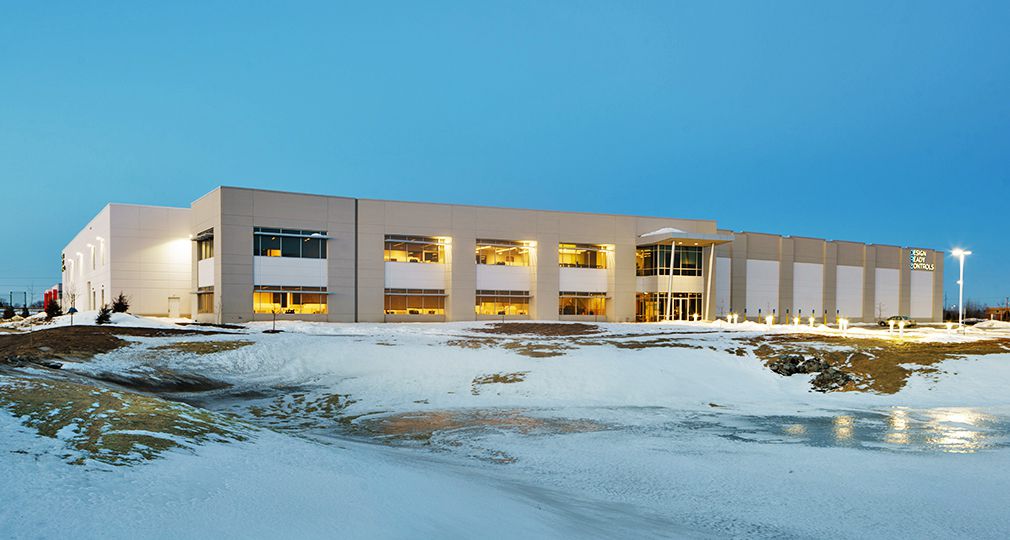
In 2014 we met with the owner (Troy) of Design Ready Controls. Troy was going to build a new 100,000 Sq.Ft. office, manufacturing and assembly facility in Brooklyn Park, MN.  Design Ready Controls – Brooklyn Park, MN – Premier Energy USA   He had already hired an engineering firm to give their recommendations. Recommendations not only on how to build, but to operate his new building most efficiently. Troy had heard about the ThermaRay Heating Systems from a local rep firm. At Troy’s request the engineering firm contacted us to include and compare our Thermal Mass Heating System as an option in their report.

We spent a few hours with one of the engineers and received the report a few weeks later. After the report came out, we received a call requesting a meeting with the Troy. We obviously agreed and after pleasantries the first question Troy asked us was “What did we think about the report ?” Homepage – Design Ready Controls

Opinion & Actual Results

Our opinion was harsh “If the other conclusions in the report were as far off as it relates to the ThermaRay System, then it was a total waste of his money”.  It was a 42-page report which along with many other recommendations compared the ThermaRay’s Thermal Mass System to natural gas hydronic and rooftop forced air systems. The report said that each heating system would cost approximately the same to operate ($96,000 per heating season).

We talked extensively about how Thermal Mass and radiant heat really work along with other benefits such as: No maintenance or replacement, cleaner, healthier, quiet, level of comfort, efficiencies, etc. In addition, and based on our experience, history, and calculations, we showed him that the ThermaRay heating system would cost less than $30,000 to operate per heating season.

He decided that day to go with the Thermal Mass System and for 7 Seasons now has never had a heating season over $30,000. Many seasons were considerably less. As we were leaving our first meeting with Troy, he said to us “By the way, I paid $27,000 for that report”. We responded, “That’s OK, we will save you more than that on the first heating season”. To date, we’ve saved Troy close to a half million dollars in operating costs compared to what the report estimated. https://youtu.be/sSchl5vyVEY

Time & Money

Design Ready Controls Installation (104,000 Sq.Ft.) began on a Friday at noon and was done by the following Monday at noon. The crew did work all weekend, but it literally only took 8-10 hours on the production schedule to install the entire heating system. The hydronic system was estimated to take 4-6 weeks and the Styrofoam insulation typically required would have been an additional $100,000 not including labor. That would be $200k-300k at today’s prices.  Recently, we completed an installation for a 30,000 Sq.Ft. building was started and finished on the same day, also only taking 8 hours day on the schedule.

The System

The System by itself is a very simple system. It consists of a double Teflon coated heating element wire embedded in sheetrock. The sheetrock panels are 18” wide and typically 7’ Long. There are other sizes to work around obstructions such as plumbing, footings, drains, etc. (See attached Spec Sheet). Each heating panel is tested twice at the factory and are also available in any voltage. The heating panels are laid out evenly across the floor and wired in parallel with direct bury wire and typically terminated in the mechanical room. A circuit of heating panels typically consists of 6-9 panels wired in parallel on a circuit (See attached example of a layout). 6”-10” of acceptable medium is placed over the top of the heating panels and prepared for concrete. https://youtu.be/hqwLV1yH1Ro

Invisible Controls

Although the heating system itself is simple, the controls make the system even more efficient than in recent years. For over 40 years, the system was simply controlled by a thermostat turning on contactors. In and of itself, still very energy efficient due to the Thermal Mass created. Now we employ strategies that elevate the efficiency of the system and added a multitude of options including “Invisible” controls.

Invisible heating systems and now invisible controls. We have homes, buildings and other structures where you will see absolutely no thermostats or controls in the entire building. No “visible” device is required in the space to control the space. If we know what’s going on in the space and then we can control the space. This is accomplished with sensors instead of devices. The sensors we employ are nondescript or completely invisible unless you know where they are located. (See Attached ProControl Options Flyer)

Unprecedented Data & Control

Premier Energy installed a ThermaRay Thermal Mass Floor Heating System in a building in Blaine, MN. In and of is itself nothing new or unprecedented. However, the manner in which we are monitoring and controlling the building is groundbreaking. The data being compiled is truly unprecedented. Unprecedented Data Collection & Efficiency – Premier Energy USA  The heating system under the concrete was wired it in such a manner as to be able to cycle, stage and modulate the floor heat. Allowing us to control the space at its maximum efficiency.

For example, instead of turning on all the circuits in a bay/space we can turn on the exterior circuits at the beginning of the heating season and add more as necessary. We also placed 38 Sensors in and around the building. (25) Concrete/Floor sensors, (8) Space Sensors (1’, 5’, 11’ & 22’ High), (4) below ground sensors at depths of 1’, 2’, 3’ & 4’ to track the depth of the Thermal Mass and (1) Outdoor Sensor. (See Attached layout with sensor locations) The controls and the sensors for the heating system can also monitor or control HVAC components to optimize efficiency, longevity, and safety.

Total Building Automation System, security, lights, etc. can also be incorporated. Everything is visible and controllable from either a remote location, a smartphone or any computer with real time tracking and data collection. The data we’ve collected substantiates everything we’ve known for decades.

Electrification & Incentives

With the trend going towards electrification, the timing couldn’t be better for the addition of our control options and strategies. The sensors and controls not only allow us to zone, stage, cycle and modulate but incorporate with any electric programs offered by the local provider. Peak demand issues can also be monitored, controlled, and addressed with these advanced options.  Many power companies have very advantageous programs perfectly suited for our Radiant Heating Systems, especially the Thermal Mass System. Some also offer rebates and custom rebates to install and control the ThermaRay Systems.

Features & Benefits:

  1. Considerably less space required in mechanical room vs. hydronic (Tubing) systems.
  2. Qualifies for the Off-Peak program offered by almost all the power companies in Minnesota. Most hydronic systems do not qualify, but it depends on the power supplier.
  3. Initial material cost is less to install compared to hydronic. Typically a quarter to half the cost for installation.
  4. 35% – 70% less cost to operate vs. hydronic or forced air. Depends on the power source, but even lower operating cost than those using natural gas as a source.
  5. Save Exponentially on Styrofoam insulation (Materials only, not including labor). Not required for our thermal mass system, but typically associated with hydronic systems.
  6. Simple Installation – Fraction of the time vs. tubing
  7. Healthiest Environment
  8. Maintenance Free
  9. No eventual repair or replacement of parts like is associated with a hydronic system.
  10. Lowest overall lifetime cost vs. “Any” other heating system.
  11. Quiet
  12. No moving parts
  13. Unlimited control options. From simple to remote access point for entire home and up to Wi-Fi accessible from your phone
  14. Not only an Invisible heating system , but we have options so that you don’t see thermostats in any room. Very clean and aesthetically pleasing.
  15. Qualifies for up to 15 LEED Points.
  16. 45+ Year stellar track record with no failed systems

Limited Mass – Snow Melting System (Under Concrete, Pavers, or Asphalt)

Most if not all other snow/ice melting system are installed directly in the concrete. The biggest mistake you can make is to install any system directly in the concrete. Contraction, expansion, heaving, cracking, settling, and shifting are all factors to help destroy the heating system. Not to mention the chemicals in concrete that erode other materials.

ThermaRay’s limited mass snow & ice melting systems are below the wear surface and protected from all those factors. Factors that “Will” eventually destroy the heating system. Automated snow/ice removal on sidewalks, entrances, ramps, aprons, driveways, etc. greatly reduces labor, liabilities, maintenance, and erosion caused by chemicals and salt. There are a multitude of control options as well. (See attached Flyer)

Bottom Line

Thermal Mass Floor Heating System with the control options and programs available are an unbeatable combination and can easily interface with any other HVAC, Lighting and Security equipment and systems.

error: Content is protected !!