
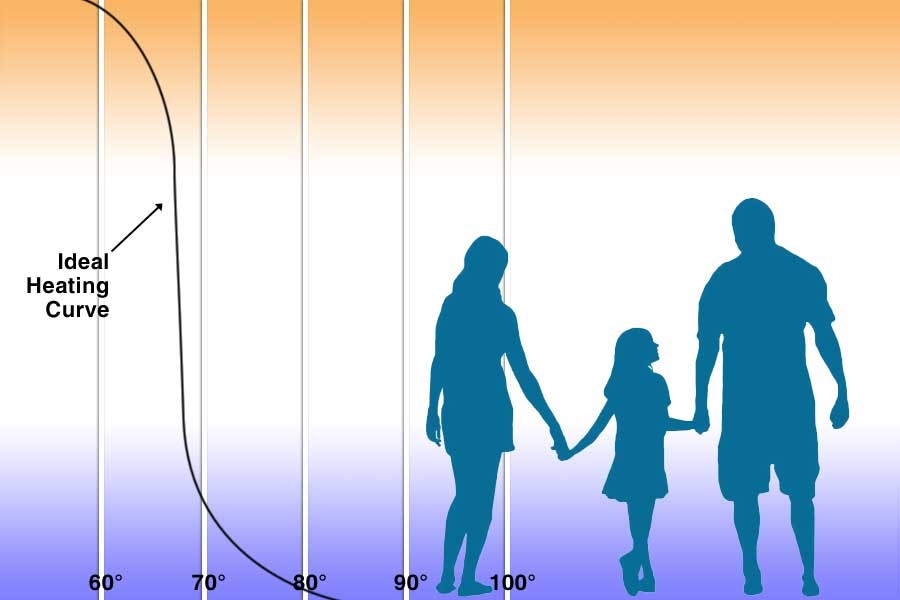
How do we achieve Ideal Heating Curve for your Comfort?
Let’s compare the different ways our worlds are heated. It has been studied and published that for optimal human comfort, thinking and performance, the temperature around your head and shoulders should be 65° to 68° degrees. The “Ideal Temperature” if you will. The old adage “If your feet are warm, then your whole body will be warm” is also indicative of the same goal for human comfort and performance. Since your feet are the farthest away from your heart, it stands to reason that this is also the hardest part of the body to keep warm.
The Ideal Heating Curve shown reflects the temperature mentioned above for optimum performance and comfort of the human body. 65° to 68° degrees at the head and shoulders and 82° to 85° degrees at the floor.

Forced-Air World
75° to 85° degrees at the head and shoulders along with the 62°-to-65°-degree temperatures at the floor are counterproductive to what is Ideally required for optimum personal comfort and performance. The area between the Forced-Air heating curve and the Ideal heating curve also represents wasted energy and higher heating bills.
Wasted Energy
Forced-Air systems have the greatest amount of wasted energy, with the heat collecting at the ceiling and is always looking for a way to escape the pressurized space. Because the hot air collects at the ceiling it dries eyes, noses and throats during the heating season. The choice is either cold feet or hot heads. The temperature at floor level never reaches the desired level, and the temperature of the ceiling is too hot. Add to this equation unnatural convection or air movement, that can alter the heat loss balance of the human body.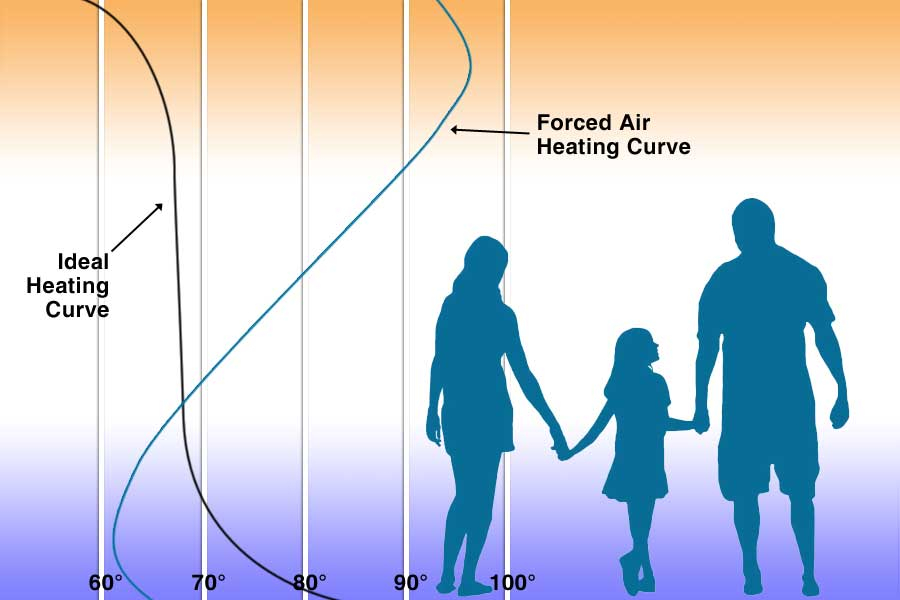
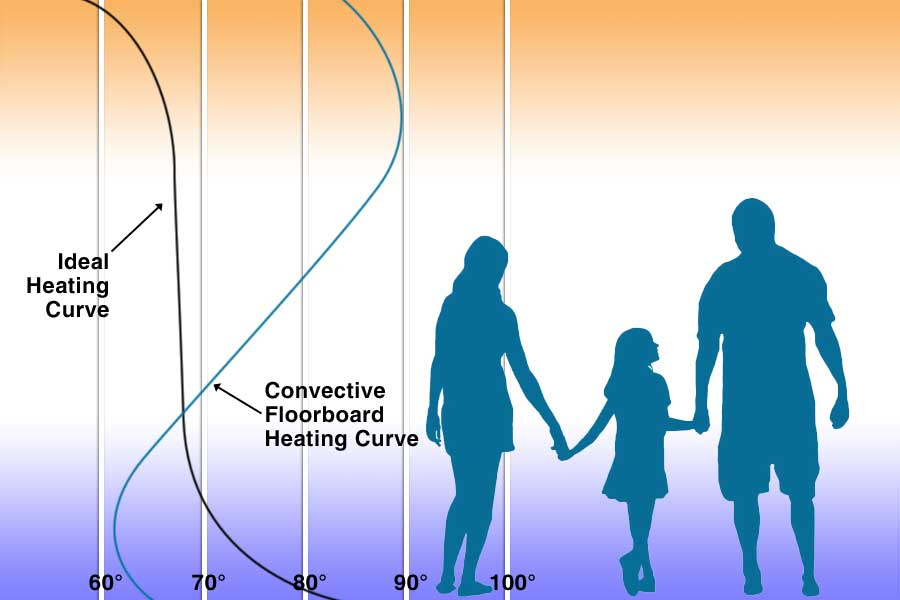
Convection World (Baseboard and Radiator)
Pretty much the same environment as the forced air world, but typically located on the outside walls of the space. The higher temperature of the heaters create a current of heat that travels up the wall. it then crosses the ceiling and cooling as it goes. When you’re close to a baseboard the heat feels warm, but the temperatures throughout the rest of the room will vary greatly. Again, the air collecting at the ceiling with a large amount of wasted energy.
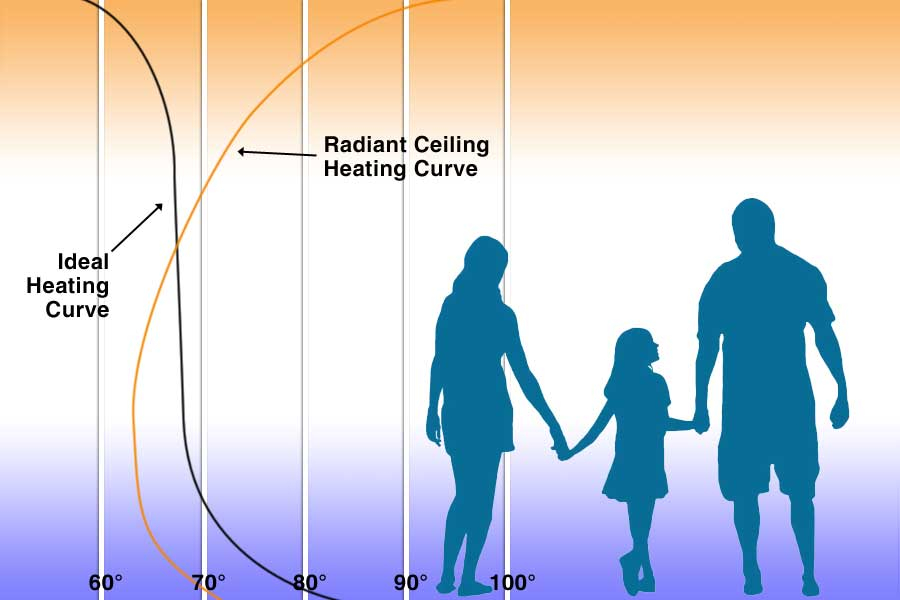
Radiant Ceiling Heat World
WHAT! Emphatically, the most common response is “Why would you want to put the heat in the ceiling if hot air rises” Although it is a fact that hot air rises, radiant heat does Not. Like the suns rays they travel in straight lines like a flashlight light. The rays go out until it hits an object that can absorb that warmth or light. We’ve all experienced the comfort and warmth of radiant heat when we step from the shade to the sun on a cool day. Even the plants and flowers enjoy the warmth of radiant heat on cold day.

The ceiling heating curve shows that the temperature at the head and shoulders is drastically closer to the curve than traditional systems. It also raises the temperature of the floor to the mid 70’s. The wasted energy is exponentially less and it creates a healthy efficient space. Comparatively, it’s like walking into a room with the sun shining, gently warming the entire space and more importantly – You!
Radiant Floor Heat World
Floor Heating come as close to the ideal heating curve that you can possibly achieve. Floor heating systems create a warm comfortable living environment that directly addresses the heat loss and personal comfort of the people in the room and as you’ll notice the heat loss and waste at the ceiling is drastically reduced.
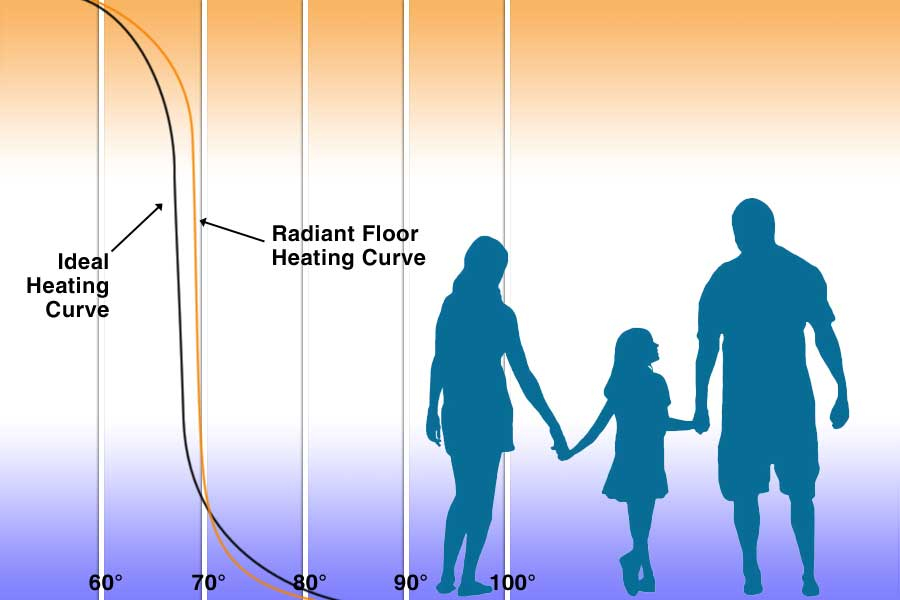
Not only do radiant floor heating systems warm your feet but it also warms your body. Unquestionably more comfortably than any other heating system available on the market today. The lower the temperature at the ceiling, the less the heat is lost through the ceiling and the lower the operating cost. The temperature at the ceiling really doesn’t matter because nobody’s lives up there anyway.
Not only do the radiant rays directly warm you when you walk into the space, but the warmth is absorbed into the walls, floor, furniture and all the objects in the room creating Thermal Mass. This Thermal Mass in turn also helps keep the room warm and adds exponentially to the efficiency of the heating system.
Thermal Mass Thermal Mass Thermal Mass ! – The radiant ceiling and the radiant floor heating systems enlist all the parts of the room to help with keeping the space warm. the floors, walls, ceiling, furniture and everything in room become part of the heating system by absorbing the radiant rays and releasing it back into the space as it cools. The larger the thermal mass, the lower the operating costs.
Premier Energy USA: Thomasnet.com
Electric Radiant Floor Warming Systems (premierenergyusa.com)
David vs. Goliath or Radiant vs. Forced Air « Green Energy Times