
Although there are many ways to get warm and comfortable, as a building owner you are concerned with the comfort as well as controlling your energy costs.
Heating Challenges
The heating challenges in your building change as you move from one room to another.
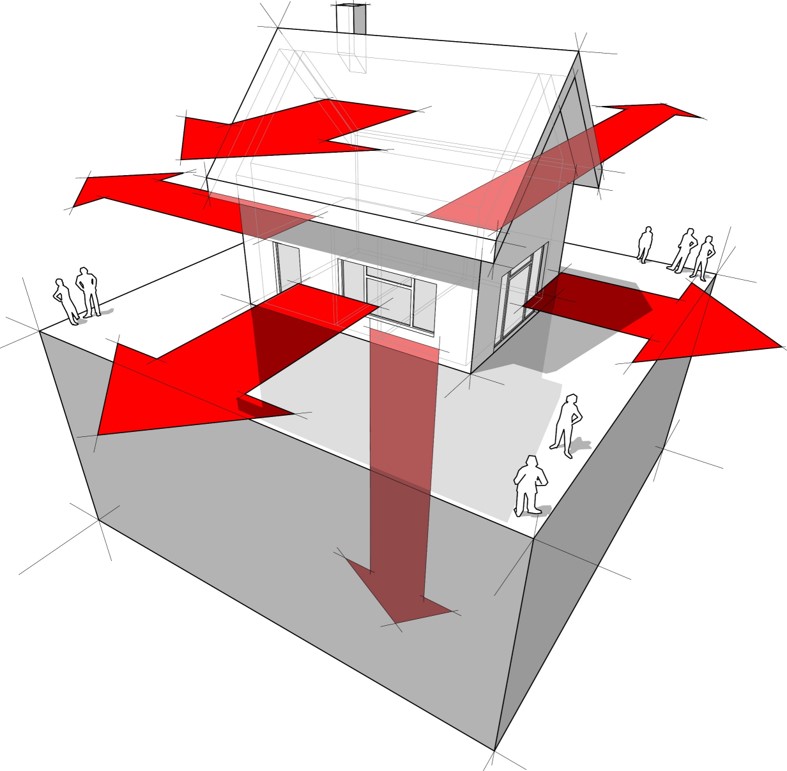
The core problem is caused by wide variations in heat loss in each area. But in every area, you need to be concerned about losing heat:
Ceilings
High, poorly insulated ceilings are a key source of heat loss. You need to lock that heat in so it doesn’t fly to the sky.
Walls
Poor wall insulation is another source of heat loss. It’s a slow and steady loss of heat energy that adds to your heating costs every month.
Doors
As your doors are opened and closed, your heating expenses skyrocket.
Windows
Poorly insulated and sealed windows are a major source of heat loss as well as an area of discomfort for those seated near the window.
Floor
Yes, even your floor is a problem area for heat loss.
But wait! Doesn’t heat rise?
If so, how can your floor be a source of heat loss?
A New Heating Paradigm
Let’s ask that question again. Does heat rise?
Surprisingly, the answer is no, heat does not rise.
It’s hot air that rises. Conversely, heat is attracted to cold.
It’s basic physics. Heat goes to cold in any direction.
If it is cold at the ceiling of your building, heat will move in that direction. The same is true for your walls and even your floor. But the real problem areas are your windows and doors.
Not because heat is rising (remember – that’s hot air), but because your windows are colder than the temperature of the room and every time your doors open heat is attracted to the cold outdoors.
As you consider this new heating paradigm, ask yourself – why would I heat my building by blowing hot air?
You would never let your building expenses escape through your ceiling, walls, floor, windows and doors, if you understood you can lock up and control those costs for your building.
Get the Lowest Total Cost of Heating System Ownership for Your Home